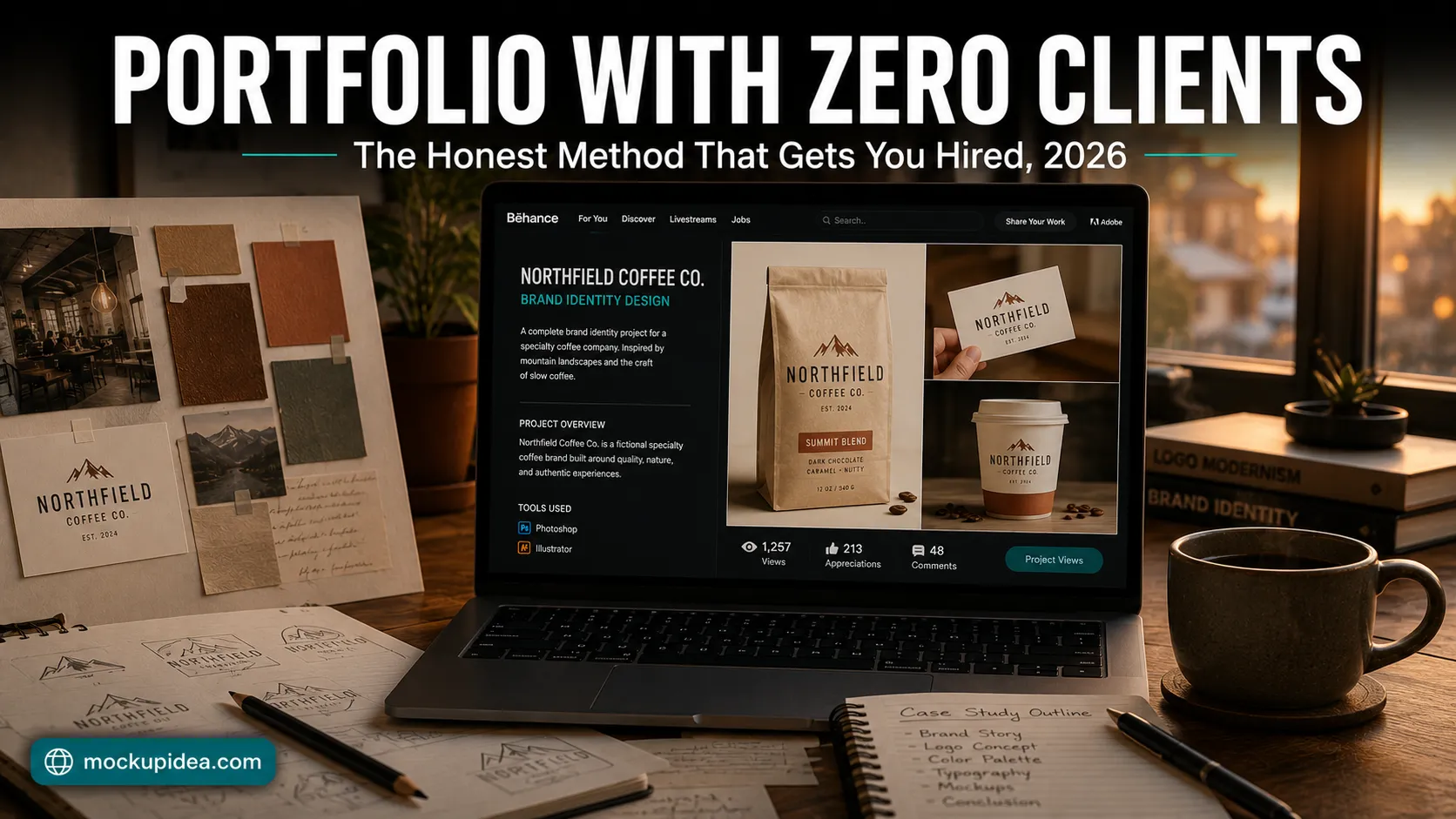
How to Build a Design Portfolio With Zero Clients in 2026 (The Honest Method)
You do not need a single paying client to build a portfolio that gets you hired. This guide covers the full method working designers used to start, from inventing realistic briefs to presenting fictional projects in mockups so convincing that hiring managers judge the thinking instead of the resume.
A
Abdul Manan
·July 5, 2026·7 min read·67
How to Build a Design Portfolio With Zero Clients in 2026 (The Honest Method)
Every designer faces the same paradox at the start. You need a portfolio to get clients, and you need clients to fill a portfolio. Thousands of talented people stall right here, refreshing job boards and telling themselves they will apply once they have real work to show. Meanwhile the designers getting hired figured out something simple. Nobody is checking whether your projects were paid.
Here is the method in short. Invent four to six realistic briefs for fictional businesses, solve each one the way you would for a paying client, document your process, present every project as a case study rather than a gallery image, and show the final work in professional mockups so it reads as real world design rather than classroom exercises. Label the work as self initiated, because honesty here costs you nothing and getting caught pretending costs you everything.
That last part surprises people, so let us start there.
Fictional Projects Are Not Cheating
Hiring managers and clients evaluate portfolios for evidence of thinking. Can you take a business problem, make strategic decisions, and execute them cleanly. A self initiated project demonstrates all of that just as well as a paid one, and the industry knows it. Agency creative directors built spec work for decades. Design school portfolios are entirely fictional projects. The practice is standard.
What actually damages you is presenting fictional work as paid client work. It is an easy lie to catch, a reference check or a casual question about the client relationship unravels it, and it converts an impressive portfolio into a character problem. A simple label like concept project or self initiated brief in the case study removes all risk while costing you none of the impact, because the person reviewing your work is judging the decisions, not the invoice.
Step One. Write Briefs That Feel Like Real Businesses
The difference between student work and portfolio work starts with the brief. Design a logo for a coffee shop is a classroom prompt. A specialty coffee roaster in a mid sized city needs an identity that justifies premium pricing to customers who currently buy from supermarkets is a business problem, and solving it produces work with a story attached.
Write each brief before touching any design tool, and include four things. Who the business is, who their customer is, what business outcome the design must produce, and one real constraint like a tight palette, a legal requirement, or an unusual format. Constraints are where interesting decisions come from, and decisions are what case studies are made of.
If inventing businesses from nothing feels slow, brief generators like Good Brief and Sharpen produce realistic scenarios instantly, and redesigning a real local business that has weak branding works too, presented respectfully and labeled as an unsolicited concept.
Pick your four to six projects to cover range. One brand identity, one packaging project, one print piece like a flyer or menu, one digital piece. A small set of deep projects beats twenty shallow ones every time, and every guide worth reading agrees on that number.
Step Two. Document the Process While It Happens
A case study needs a middle, and the middle is your process. Photograph your sketches. Save your mood boards. Keep the three directions you rejected and write one line on why each lost. This feels like clutter while you are working and becomes the most persuasive part of the portfolio later, because process is the part that cannot be faked with one lucky final image.
Structure each case study the same way. The brief and the audience, the problem in one or two sentences, the exploration with sketches and rejected directions, the solution with rationale, and the final work shown in context. A reviewer should be able to follow the whole project in ninety seconds of scrolling.
Step Three. The Mockup Presentation, Where Fictional Becomes Professional
Here is the step that separates portfolios that get responses from portfolios that get silence. A logo floating on a white artboard looks like homework. The same logo on a shopfront, a coffee bag, a business card held in a hand, looks like a brand that exists. Context does the persuading, and mockups are how you manufacture context without a single real product.
Use three or four scenes per project, not ten. Each project needs enough context to feel real and not so much that the case study becomes a mockup gallery.
And when no template exists for your fictional product, build your own scene from any photo using the smart object method in our step by step tutorial at https://www.mockupidea.com/blog/how-to-make-your-own-mockup-from-any-photo-2026. An unusual scene nobody else has is worth more in a portfolio than anywhere else, because standing out is the entire assignment.
Step Four. Put It Somewhere and Ship It Imperfect
Behance and a simple personal site cover ninety percent of situations. The platform matters far less than the case study quality, so do not spend three weeks choosing a portfolio builder while zero projects exist.
Ship at four projects, not at perfect. A live portfolio with four strong case studies starts generating conversations, feedback, and sometimes work, and every one of those improves the next project. The designers who wait for perfect launch a year later into the same job market with the same four projects they could have shipped in month one.
Then replace fictional projects with real ones as they arrive. The portfolio you build with zero clients is scaffolding, and its job is to make itself obsolete.
The Checklist
Four to six projects covering identity, packaging, print, and digital.
Every project starts from a written brief with a business problem and a constraint.
Process documented while working, sketches, mood boards, rejected directions.
Every project presented as a case study a reviewer can follow in ninety seconds.
Final work shown in three or four customized, industry matched mockups.
Fictional work labeled as self initiated, everywhere, without exception.
Can I put fake projects in my design portfolio?
Yes, self initiated and concept projects are standard practice across the industry, from design schools to agency spec work. The one rule is labeling them honestly as concept work rather than claiming paid clients that do not exist.
How many projects does a beginner portfolio need?
Four to six deep case studies. Reviewers spend minutes per portfolio, so a small set of thorough projects with visible thinking beats a large gallery of finals with no story.
Do mockups make a portfolio look more professional?
Dramatically, when they are customized and matched to the project's industry. Work shown in realistic context reads as real world design, while finals floating on white artboards read as classroom exercises.
Where should a beginner host their portfolio?
Behance or a simple personal site both work. Case study quality decides outcomes far more than platform choice, so build the projects first and choose the container after.
Should I redesign real brands for my portfolio?
It works well when labeled clearly as an unsolicited concept and done respectfully. Choose businesses with genuinely weak branding where your redesign solves a visible problem, and never imply the company hired you.