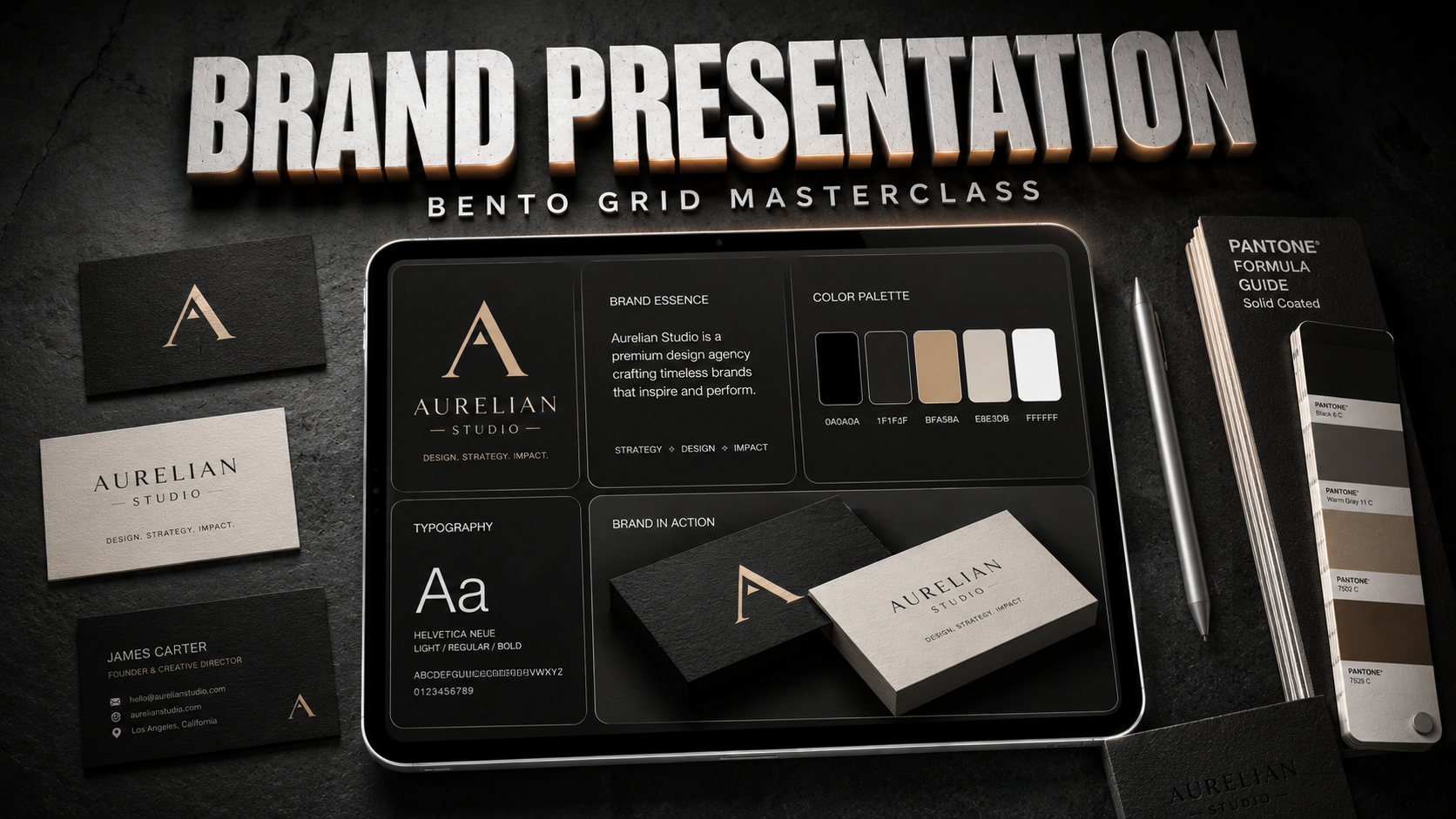
How to Present Brand Identity to Clients in 2026: The Bento Guide
A client doesn't buy a flat vector file; they buy a vision. In 2026, presenting a logo on a blank white PDF is the fastest way to trigger client revisions and decision paralysis. From the psychological power of the "Bento Grid" layout to hyper-realistic physical mockups, here is the masterclass on how top agencies present brand identities to win instant approvals.
A
Abdul Manan
·June 5, 2026·7 min read·111
You have spent weeks researching, sketching, and refining a world-class brand identity. The typography is flawless, the color palette is perfectly balanced, and the logo mark is highly scalable.
But when you present it to the client, they hesitate. They ask to "make the logo bigger," or worse, they want to see "a few more options."
Why does this happen? Because clients cannot visualize flat artwork in the real world. When you present a 2D vector on a white background, you are forcing the client's brain to do the heavy lifting of imagining how that logo will look on a storefront, a business card, or a mobile app.
In June 2026, design agencies have completely overhauled how they pitch brand systems. The era of the 50-page, text-heavy PDF presentation is over. Today, winning client approval relies on two core strategies: The Bento Grid layout to reduce cognitive load, and Photorealistic PSD Mockups to prove real-world viability.
Here is the exact step-by-step masterclass on how to present brand identities to high-value clients in 2026.
1. The "Rule of Three" and Narrative Precision
The biggest mistake junior designers make is over-delivering. Presenting six or seven logo concepts does not prove you worked hard; it triggers "decision paralysis." It signals to the client that you are not the expert and are asking to do the art direction.
In 2026, elite agencies present exactly three refined directions.
Before a single visual is shown, the presentation narrative must begin with a recap of the strategic business objectives. You must frame the logo as a functional business tool—appropriate, simple, and memorable—not an object of personal subjective art. When the client evaluates the design, they should be asking, "Does this solve our business problem?" rather than, "Do I personally like this shade of blue?"
2. The Bento Grid Presentation Model
To showcase a cohesive brand system, top design studios have universally adopted the Bento Grid presentation model.
Inspired by the compartmentalized structure of Japanese lunchboxes, the Bento Grid utilizes asymmetric blocks of varying sizes to display an entire brand system coherently on a single slide. Instead of clicking through 15 different pages to see the logo, typography, color swatches, and application, the client sees the entire ecosystem working in harmony at once.
Why the Bento Grid Works (The Psychology)
The Bento Grid leverages Gestalt psychological principles to reduce the client's cognitive load:
Law of Proximity: By grouping logo variations, UI elements, and business cards into individual rounded blocks, the client's brain categorizes them as a unified functional system.
Law of Similarity: Enforcing uniform border radii (typically 12px to 24px) and consistent shadow depths creates immediate visual harmony.
Law of Prägnanz: It divides complex brand guidelines into clean, asymmetrical rectangles, minimizing visual chaos.
The data backs this up: creative agencies implementing responsive Bento Grid layouts for their brand reveal decks report a 47% increase in client dwell time and significantly faster approval rates.
3. Context Over Vectors: The Physics of Reality
Even inside a beautiful Bento Grid, a flat logo is not enough. You must anchor the brand in physical reality.
Recent presentation data reveals that concepts showcased using high-fidelity, photorealistic environmental mockups yield up to a 27.4% higher first-round approval rate compared to standard flat vectors. If you want the client to pay premium agency rates, the work must look expensive.
Basic web-based mockup generators (like Canva or Placeit) fail here because they lack proper displacement mapping—they just slap flat logos onto stock images. To prove that a brand identity is robust, you must use professional PSD mockups that force your design into the shadows, fabric textures, and glass reflections of the real world.
4. The 4 Mandatory Mockups for Every Brand Pitch
When building your brand presentation, you need to prove the identity works across different physical mediums. Here are the four essential free PSD mockups you should download from MockupIdea to build your perfect presentation deck:
The Premium Tactile Touchpoint (Business Cards)
Clients want to know the brand feels premium in the hand.
You do not need to spend hours rendering 3D environments to achieve this level of quality.
Design the Core: Finalize your three vector brand directions in Illustrator or Figma.
Download Premium Assets: Go to MockupIdea.com and download 3 to 4 free, commercial-use PSD mockups (Business Card, Screen, Signage, Packaging).
Apply via Smart Objects: Open the PSDs in Photoshop (or the free browser tool, Photopea). Double-click the Smart Object, paste your logo, and save. The file will automatically warp your logo into the physical textures and shadows of the scene.
Build the Bento Grid: Export your high-resolution mockups and arrange them into a clean, rounded-corner Bento Grid layout in your Figma or Keynote presentation deck.
When you present the final slide, your client won't just see a logo. They will see a living, breathing brand ecosystem. They won't ask for revisions; they will ask how fast you can launch it.
What is a Bento Grid presentation layout?
The Bento Grid is a UI and presentation design trend inspired by Japanese bento boxes. It uses a grid of different-sized rectangles with uniform spacing and rounded corners to display multiple pieces of content (like logos, colors, and mockups) cleanly on a single slide without overwhelming the viewer.
Why should I use PSD mockups instead of flat PNGs for brand presentations?
Flat PNGs lack physical context. PSD mockups utilize displacement mapping to warp your design around 3D objects, adding realistic lighting, shadows, and textures. This physical plausibility increases client trust and significantly boosts first-round approval rates.
Can I use MockupIdea PSDs in client presentation decks?
Yes. Every mockup downloaded from MockupIdea comes with a full, unrestricted commercial-use license. You can use them in client pitches, brand guidelines, and portfolio case studies without any attribution required.
How many logo concepts should I present to a client?
Industry standard in 2026 is to present exactly three highly refined, distinct brand directions. Presenting more than three causes decision fatigue and diminishes your authority as the strategic expert.