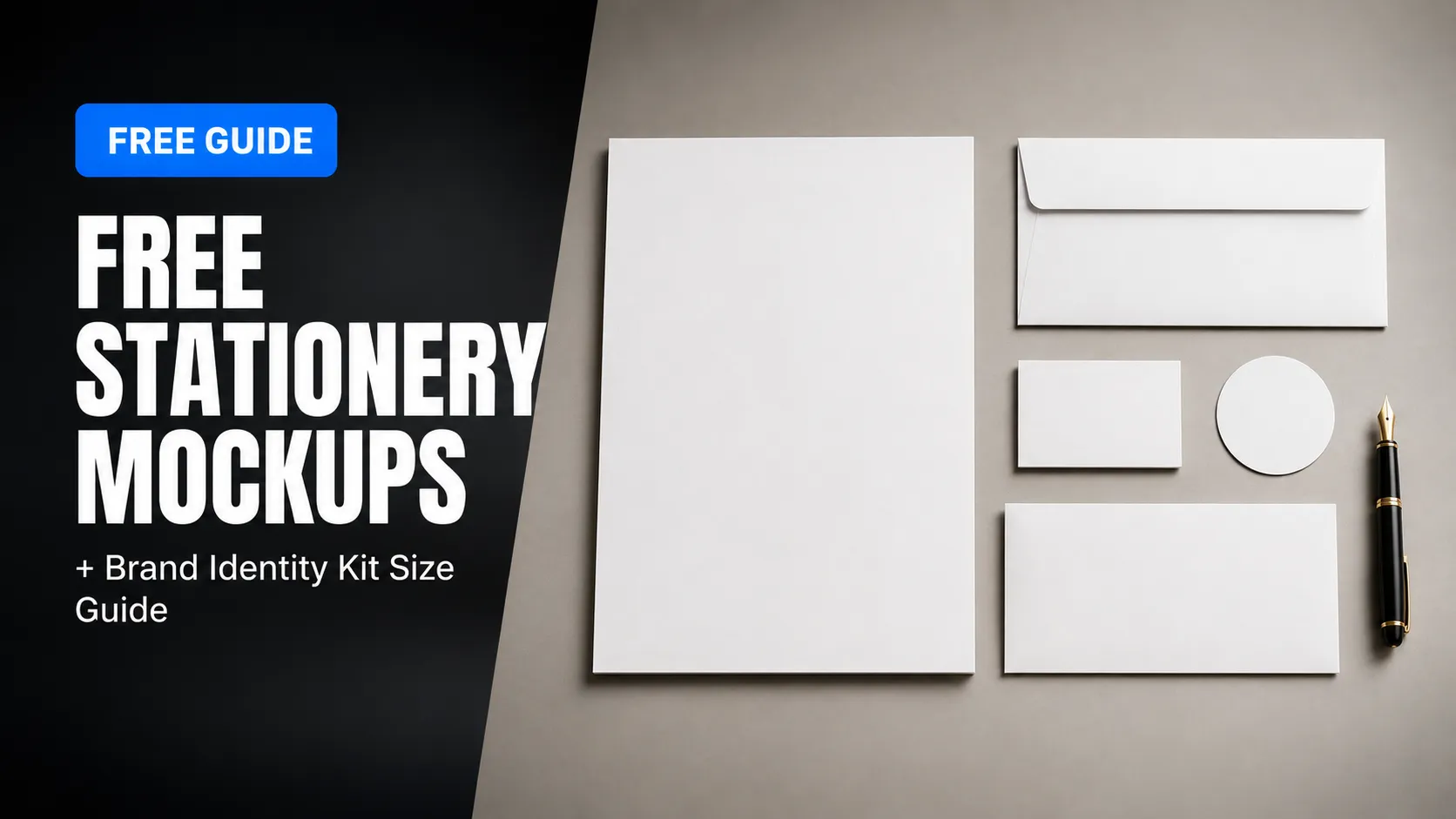
Free Stationery Mockups & The Brand Identity Kit Size Guide
The world runs on two incompatible paper systems. A4 is the most commonly available paper size on earth — everywhere except North America, the Philippines, and parts of Latin America, where 8.5x11 Letter rules instead. Design a letterhead at the wrong one and your client's printer rejects it. Here is every piece of a brand identity stationery kit, the exact size it should be in both systems, and a free mockup PSD for each.
A
Abdul Manan
·July 25, 2026·11 min read·26
There is a mistake that shows up in brand identity
presentations constantly, and almost nobody catches it until
the files reach a printer.
A designer builds a beautiful letterhead at 8.5" x 11". The
client is in Berlin. Their printer needs A4 — 210 x 297 mm.
Those are not the same shape. A4 is narrower and taller. The
margins collapse, the logo sits wrong, and the whole system
has to be rebuilt.
ISO 216 — the A-series standard — is used across the
entire world except North America, the Philippines, and
parts of Latin America. A4 is the most commonly available
paper size on the planet. If you only ever design at US
Letter, you are designing for a minority of the world's
printers.
This guide is the fix. Every piece of a stationery kit,
what size it should be in both systems, which envelope it
folds into, and a free mockup PSD to present it with.
The Stationery Kit Size Reference
Every dimension below is from ISO 216 (paper), ISO 269
(envelopes), or USPS mailing standards.
The A-series has one property worth understanding: every
size has a √2:1 aspect ratio, and each size is exactly
half the area of the next one up. Fold A4 in half and you
get A5. Fold A5 in half and you get A6. The proportions
never change.
US sizes do not work this way. Fold 8.5 x 11 in half and you
get 5.5 x 8.5 — a different aspect ratio entirely. This is
the single biggest reason an A4 design does not translate by
simple scaling.
Envelopes — What Actually Fits
Envelope
Size
Holds
DL
110 x 220 mm
A4 folded in thirds
C6/C5
114 x 229 mm
A4 folded in thirds
C6
114 x 162 mm
A6 — A4 folded twice
C5
162 x 229 mm
A5 — A4 folded once
C4
229 x 324 mm
A4 unfolded
No. 10
4⅛ x 9½" (105 x 241 mm)
Letter folded in thirds
DL is the international business envelope. The name comes
from DIN Lang — German for "long" — a format that dates to
the 1920s. No. 10 is the standard business envelope in the
United States.
Note they are close but not equivalent: DL is 110 x 220 mm,
No. 10 is 105 x 241 mm. A DL insert will not sit correctly
in a No. 10. If your identity system ships internationally,
you need both artboards.
One practical footnote: ISO 269 was formally withdrawn in
2009 without replacement, but the sizes remain the working
standard and the German DIN 678 standard defines a near
identical list. Printers still quote in DL, C5, C4.
The USPS Size Limit Nobody Mentions
If you are designing a custom envelope for the US market,
this constrains you. To mail at standard letter pricing, an
envelope must be rectangular and:
At least 3.5" high x 5" long x 0.007" thick
No more than 6⅛" high x 11.5" long x 0.25" thick
Design a square envelope or push past 6⅛" tall and your
client pays a surcharge on every single piece they mail.
Worth raising before the design is approved.
1. Letterhead — The Anchor Piece
The letterhead sets the grid the rest of the system
inherits. Build it at A4 and US Letter from the start.
A stack of A4 sheets shot in perspective on raw concrete.
The stack depth shows paper stock weight, and the hard
industrial surface suits architecture, studio, and
construction-sector identities.
A single sheet on marble with a wax seal stamp. The seal
signals authority and tradition — the right frame for legal
practices, notaries, luxury brands, and private clients.
Marble again, styled with a black and gold pen. The metallic
accent gives gold-foil and metallic-ink letterhead concepts
a realistic reference point in the same frame.
A card and envelope pair with visible recycled fibre grain.
Use this when the identity leans sustainable — the texture
does the communicating that a flat white render cannot.
Individual pieces prove execution. The set shot proves the
system — that the logo, palette, and type hold together
across formats. This is the image that goes at the top of
the deck.
Stationery Set — Letterhead, Cards, Envelope, Sticker
Four core pieces in one composition. The most complete
single-frame summary of a small identity system.
Straight-down overhead. Zero perspective distortion, so
every piece reads at true proportion — the honest option
when a client is judging layout rather than atmosphere.
Branding Set — Window Envelope, Blue Card, Paperclip
Features a window envelope — the format where address
alignment actually matters, because the recipient's address
has to fall inside the die-cut aperture. If your client
mails invoices or statements, present this one.
Stickers seal envelopes, close packaging, and get given
away. No standard size governs them, which is precisely why
you should present them at a decided size rather than
leaving it open.
Round Sticker With Lifted Edge — Flat Lay
One corner peeled up. The lifted edge is what makes a
sticker read as a physical object rather than a circle
pasted onto a photograph.
6. ID Badges & Lanyards — The Piece Clients Forget
Any identity for a company with staff, an event, or a campus
needs a badge. It is almost never in the original brief and
almost always requested later.
ID Card Lanyard — Two Badge Holders
Two vertical badge holders side by side on branded lanyards
with metal swivel clips. The dual format lets you show two
colour variants, two departments, or two access levels in a
single export — the comparison view approvers ask for.
A single badge in a real office environment. Contextual
rather than isolated, which suits the "life at our company"
page of a brand guidelines document.
Where a kit becomes a system: the surfaces nobody specified
but everybody notices.
Tent Calendar — Desk Lifestyle With Gold Glasses
A folded desk calendar in a styled workspace. Calendars are
the longest-lived branded object a client will ever hand
out — twelve months of daily impressions.
An illustrated clipboard scene. Built for presenting
illustration and pattern work rather than logo systems —
the right frame for a children's brand or an editorial
commission.
Business cards are the one piece with its own deep
rabbit hole — sizes, finishes, and stock all vary by
region. That is covered separately in the
business card mockup guide.
How to Use These Free Stationery Mockup PSDs
Step 1: Download
Click any link above. No registration, no watermark, full
commercial use.
Step 2: Open in Photoshop or Photopea
No Photoshop? Photopea at photopea.com is a free browser
editor that handles PSD smart objects identically.
Step 3: Open the Smart Object
Find the layer labelled "Place Design Here" and double-click
the thumbnail.
Step 4: Paste at the Correct Aspect Ratio
This is where kits go wrong. Paste an 8.5 x 11 design into a
mockup built for A4 and Photoshop will stretch it. Check
your artwork's ratio matches the mockup's before you scale:
A4 is 1:1.414, US Letter is 1:1.294. They are visibly
different.
Step 5: Save and Export at 2x
Ctrl+S / Cmd+S, then File → Export As → PNG at 2x scale.
Frequently Asked Questions
What size is a letterhead?
A4 — 210 x 297 mm (8.3 x 11.7") — everywhere ISO 216 is
used, which is most of the world. US Letter — 8.5 x 11" — in
North America, the Philippines, and parts of Latin America.
Deliver both if the client operates internationally.
What is the difference between DL and No. 10 envelopes?
DL is 110 x 220 mm and holds A4 folded in thirds. No. 10 is
4⅛ x 9½" (105 x 241 mm) and holds US Letter folded in
thirds. DL is the international business standard; No. 10 is
the US business standard. They are not interchangeable.
Which envelope fits an unfolded A4 sheet?
C4 — 229 x 324 mm. For A4 folded once use C5 (162 x 229 mm);
folded twice use C6 (114 x 162 mm); folded in thirds use DL
or C6/C5.
Why is A4 taller and narrower than US Letter?
Every ISO A-series size has a √2:1 aspect ratio, chosen so
that folding a sheet in half produces the same proportions
at half the area. US Letter has no such relationship — it is
a legacy size.
What is the maximum envelope size for standard US postage?
6⅛" high x 11.5" long x 0.25" thick, and at least 3.5" x 5"
x 0.007" thick. Anything outside that range costs more to
mail.
What should be in a brand identity stationery kit?
At minimum: letterhead, second sheet, business card,
envelope, and compliment slip. Add a window envelope for
invoicing clients, ID badges for companies with staff, and
stickers as a low-cost extra surface. Use the checklist
above.
Do I need Photoshop for these mockups?
No. Photopea at photopea.com is free and handles PSD
smart objects exactly like Photoshop.
Can I use these mockups for paid client work?
Yes. Every file on MockupIdea includes full commercial use
with no attribution required.
Paper dimensions in this guide are from ISO 216, envelope
dimensions from ISO 269 and the US commercial envelope
standard, and mailing limits from USPS letter-rate
requirements. Confirm current specs with your printer before
production.